What is AI Governance Platform Engineering (AIGPE)?
AIGPE is the discipline of engineering a deterministic governance harness into the agentic platform — so every agent path is identity-bound, grounded, reviewed, human-gated at the autonomy level you set, and provable. It is the governance counterpart to the Agentic Development Platform: where that platform gives agents productive paths, AIGPE makes those paths governed and provable. Readiness, not certification.
The shift: from a tool in the editor to an actor in the lifecycle
Agents are no longer just a tool in the editor; they are becoming actors across the whole software lifecycle. Platform teams responded by evolving the Internal Developer Platform into the Agentic Development Platform (ADP), and the lifecycle into the Agentic Software Development Lifecycle (ASDLC) (terms: Weave Intelligence). The load-bearing insight is one Cognita has made all along: the most common failure mode isn't a model that can't perform — it's a platform that can't govern probabilistic agents at scale. The platform's hardest job is the deterministic harness that makes a probabilistic agent safe to operate. That harness is governance.
“Deterministic,” honestly
A large language model is not deterministic, and Cognita never claims it is. What AIGPE makes deterministic is the governance harness around it — and that is exactly what a regulated team needs:
- Deterministic policy — the same rules decide what an agent may do, every time.
- Deterministic gates — grounded-or-dropped and a mandatory review run on every path.
- Deterministic human gates — sign-off fires at the autonomy level you set.
- Deterministic evidence — every step sealed to a tamper-evident ledger you verify offline.
Deterministic governance around a probabilistic model — never a deterministic model.
Where governance attaches: runtime, not a document
The technical buyer's real question isn't “what's your framework?” — it's “where does your governance actually run?” The answer the field has converged on: governance has to execute at runtime — where the agent acts — or it isn't governance, it's a document. (N. Kenney: governance intent must be compiled into runtime controls that execute alongside the agent, not left in policy documents.) Your IDE, your frameworks, and your cloud get the agent to runtime; Cognita governs the agent's work and proves it — control-plane and origin-agnostic, integrating with your stack rather than replacing it.
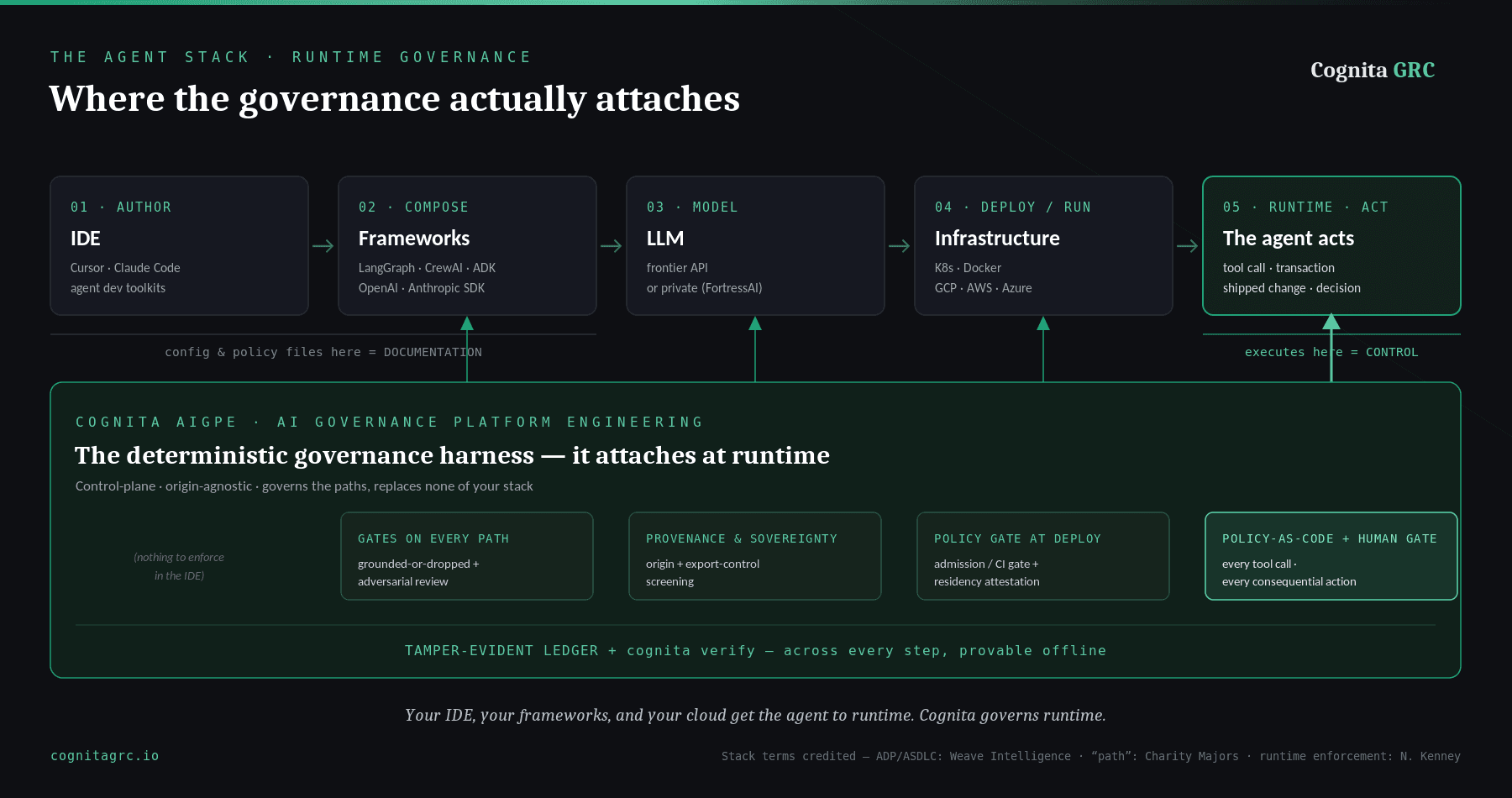
The governance pillars
AIGPE makes the governance pillars of the agent platform first-class — and provable:
Identity & accountability
A named principal and an accountable owner for every agent and path.
Evaluation gates
Grounded-or-dropped (every claim cited) plus a mandatory fabrication-and-overclaim review, on every run.
Audit & evidence
A hash-chained, tamper-evident record your reviewer verifies offline from the command line.
Readiness crosswalk
One evidence base, scored across AIUC-1, ISO 42001, the EU AI Act and NIST AI RMF.
Model provenance
Origin, licence and export-control screening for the model you run — diligence and documentation, not legal advice.
Cost governance
Per-run metering, so agent compute is governed alongside the rest of your spend.
Governance scales with autonomy
As you move agents up the autonomy levels (four-levels framework: Weave Intelligence), the governance must rise with them — so your agents never run faster than your guardrails.
| Level | Human role | What the harness enforces |
|---|---|---|
| L1 · in the loop | Executor | Citations and provenance on every suggestion; a minimal harness. |
| L2 · on the loop | Validator | Deterministic gates on every agent output; the reviewer checks the evidence, not each diff. |
| L3 · orchestrator | Orchestrator | Rule-based promotion, exception-only human review, cost governance, a full audit trail. |
| L4 · constraint-setter | Constraint-setter | Autonomous within hard, codified guardrails; a decision record on every action; escalation boundaries. |
See it on your own AI
Start with the free readiness score, then read the field of work it's built on. Readiness, not certification — accredited auditors certify.